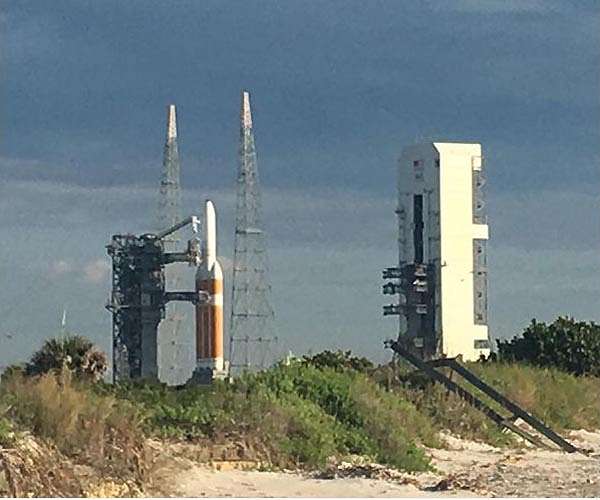
United Launch Alliance will try again to launch a spy satellite for the U.S. Department of Defense just after midnight Monday.
The company's powerful Delta IV Heavy rocket is scheduled to carry the satellite aloft at 12:02 a.m. EDT Tuesday. The rocket is a triple-core launcher that produces a collective 2.2 million pounds of thrust.
That compares to SpaceX's Falcon Heavy, the most powerful of today's rockets, with 3.4 million pounds of thrust at liftoff.
The ULA mission is to lift off from Cape Canaveral Air Force Station's Complex 37B. A 40 percent chance of thick clouds could delay the launch, according to a U.S. Space Force forecast. In case of delay, the launch could come early Wednesday or Thursday.
The launch has been delayed by various woes. On Aug. 29, controllers halted a launch three seconds before liftoff. The company blamed a faulty helium pressure regulator for that abort. The mission was further delayed due to a problem with a retractable support arm at the launch site, according to ULA.
The flight, called NROL-44, will be the 12th launch of a Delta IV Heavy, which was first used in 2004, the company said.
The National Reconnaissance Office, the agency that oversees the launch, is part of the Defense Department. According to its mission statement, it is responsible for developing, launching and operating America's reconnaissance satellites, along with data-processing facilities.
That data is used by the National Security Agency and National Geospatial-Intelligence Agency to produce photos, maps, reports and other tools for the president, Congress, national policymakers, warfighters and others.
The Delta IV Heavy, the fourth version of the workhorse Delta rocket, was developed to launch for the reconnaissance office, U.S. Space Force and NASA. It also carried NASA's Orion capsule in a 2014 test flight and sent the Parker Solar Probe into the sun's outer atmosphere.
ULA plans only three more Delta IV Heavy launches from Florida — including this week's launch — and two more from Vandenberg Air Force Base in California. After that, the company plans to use its Vulcan rocket, which is being developed.