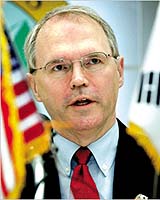
The United States said Saturday it was ready to meet bilaterally with North Korea despite its missile tests if the communist state takes part in multinational talks. But US Envoy Christopher Hill stood by the US position not to meet bilaterally outside of the existing six-nation disarmament talks, which have been on hold since November due to a boycott by North Korea.
"If there are six-party talks … we will meet all the delegations. And we've always said that they will meet and (we) have always met the DPRK delegation in the six-party talks," Hill told reporters in Seoul.
He said he was also ready to meet North Korea bilaterally if Beijing succeeded in organizing a round of informal six-way talks in the northeastern Chinese city of Shenyang.
"Even within the informal six-party talks? Yes, I can," Hill said.
"I just can't do it when they are boycotting the six-party talks," he said after meeting South Korean Foreign Minister Ban Ki-Moon.
The United States has repeatedly met bilaterally with the North on the sidelines of the five rounds of disarmament talks held in Bejiing since 2003.
Hill shook hands and spoke briefly to his North Korean counterpart Kim Kye-Gwan during a privately organized conference in Tokyo in April that drew the six top negotiators, but rejected requests for a more formal meeting.
China has been trying to organize an unofficial meeting of the six nations in July in Shenyang. It launched the initiative before North Korea defied international appeals and test-fired seven missiles Wednesday.
China's delegate to the six-way talks, vice foreign minister Wu Dawei, is expected to head to Pyongyang on Monday in the wake of the missile tests.
Hill and his South Korean counterpart in the disarmament talks, Ambassador Chun Yung-Woo, both hoped Wu could persuade Pyongyang to attend.
"As you all know, the Chinese have talked about putting together a six-party informal and we both support them," Hill said after his talks with Chun.
"We think that all countries that are prepared to come to that informal need to come and we need to get on with diplomatic tasks in dealing with DPRK and DPRK actions," Hill said, referring to the North's official name, the Democratic People's Republic of Korea.
Chun said the initiative for informal talks in Shenyang was "still alive" despite the missile tests.
"We are still working on that idea and we wish Mr. Wu well when he tries to sell this idea in Pyongyang," Chun said.
Japan says no compromise on NKorea
Japan's foreign minister said Saturday that his nation would not compromise in its push for a UN resolution on North Korea that could lead to sanctions, despite opposition from China and Russia.
Foreign Minister Taro Aso said Japan, which has a temporary seat on the UN Security Council, was resolved to keep working for a resolution, instead of a milder and non-binding Council statement, after the North's missile tests.
"We may amend the draft but we are firm on the binding resolution that includes sanctions," Aso said in a speech. "Japan will not compromise. We will go all the way."
Aso challenged China and Russia, permanent Council members with veto power, not to scupper the resolution put forward by Japan after North Korea Wednesday test-fired seven missiles that landed in the Sea of Japan (East Sea).
The draft condemns the tests and invokes Chapter VII of the UN charter, which could clear the way for sanctions or even military action. Both Russia and China, North Korea's closest ally, are opposed to any sanctions threat.
"It is unreasonable if the moods of the veto powers dominate diplomacy," Aso said.
Japanese ambassador Kenzo Oshima presented the draft resolution to the Security Council on Friday, hours after Pyongyang warned any imposition of sanctions would be regarded as an "act of war."
"We hope that it will be adopted when it is put to a vote with the broad unanimity of the council," Oshima said.
The push for a vote appeared to be a bid to dare China, which supplies impoverished North Korea with energy and economic aid, to veto the measure.
"If this resolution is put to vote, there will be no unity in the Security Council," said China's amassador to the United Nations, Wang Guangya. Asked whether he might use China's veto, he replied: "All possibilities are open."
Aso has telephoned foreign ministers of the United States, Russia, Germany and Italy to confirm that they would work together to resolve the crisis and to take up the issue at the upcoming Group of Eight summit in Saint Petersburg, the Japanese foreign ministry said.
Russian foreign minister Sergei Lavrov told Aso that Russia shared Japan's concerns.
"I have instructed our UN delegation to work closely with the Japanese delegation," Lavrov told Aso on the phone, according to the Japanese foreign ministry.
Yasuhisa Shiozaki, senior vice-minister for foreign affairs, told an press conference Saturday that Japan was having "frequent talks" with China and Russia to ensure the resolution will be approved.
"What is important right now is to send a clear message to North Korea that there is an international consensus that North Korea should not continue this course of action any more," Shiozaki said.
A North Korean official repeated demands for Japan to halt sanctions, South Korea's Yonhap news agency reported late Saturday.
"If anyone tries to put us under pressure, we will have no choice but to take stronger physical measures," Song Il Ho, North Korea's ambassador in charge of diplomatic normalization talks with Japan, told a newspaper in Japan.
Song singled out sanctions already imposed by Japan after the missile launches including banning a ferry from the hermit state entry to Japanese ports.
Bush Singles Out North Korea For Criticism