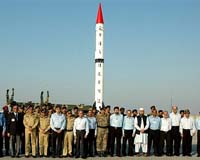
The United States is satisfied with the security of Pakistan's nuclear arsenal, US Defense Secretary Robert Gates said in an interview aired Monday, calling the arrangements in place "sufficient and adequate."
"I'm quite comfortable that the security arrangements for the Pakistani nuclear capabilities are sufficient and adequate," Gates said in an interview with Al Jazeera, the Qatar-based satellite news channel, according to a transcript.
He said that assessment was "based both on our own understanding of the security arrangements that the Pakistanis have for their weapons and their capabilities, their laboratories and so on. But also the insurances we have been given by the Pakistanis."
Gates also praised the performance of both Pakistan's military and civilian government over the past 16 months, saying it had exceeded Washington's expectations.
He said a political consensus had formed on the need to take on extremists in the Swat valley and the tribal areas, and that the government had been effective in its handling of refugees in the aftermath of the military operations against the Pakistani Taliban.
"We are very impressed by that and we are prepared to be helpful, to help the Pakistanis in any way we can," he said.
Asked about reports that the Pakistani intelligence supported Taliban groups in their war against US and NATO forces in Afghanistan, Gates acknowledged that those relationships go back to the campaign against the Soviet occupation of Afghanistan in the 1980s.
However now "I believe we are in the same trench, working for the same goal," he said.
related report
Gates urges Arabs to strengthen military ties with eye to Iran
Defense Secretary Robert Gates urged US allies in the Arab world to strengthen their military capabilities and defense cooperation with Washington as a means of pressuring Iran to back off its nuclear program.
In an interview with Al Jazeera that was to be aired Monday, Gates said the United States still favored diplomatic and economic approaches to the challenges posed by Iran and its nuclear program.
But, according to a transcript of the interview, Gates said "one of the pathways to get the Iranians to change their approach on the nuclear issue is to persuade them that moving down that path will actually jeopardize their security, not enhance it.
"So the more that our Arab friends and allies can strengthen their security capabilities, the more they can strengthen their co-operation, both with each other and with us, I think sends the signal to the Iranians that this path they're on is not going to advance Iranian security but in fact could weaken it," he said.
Gates said he did not know how much US arms sales to the region now totaled, but disputed a 100 billion figure cited by Al-Jazeera as sounding "very high to me."
The defense secretary also questioned whether Iran had gained lasting clout in Iraq, and by extension in the region, as a result of the 2003 US invasion that toppled Iraqi leader Saddam Hussein and brought the country's Shiite majority to power.
"I think that a strong and democratic Iraq, particularly one with a multi-sectarian government, becomes a barrier to Iranian influence and not a bridge for it," he said.
"So I think, in the short term, perhaps Iran's position was strengthened somewhat but I think if you look to the longer term, and the role that Iraq can play in the region going forward, I think that Iran's position may well be diminished," he said.
He said Iraq's leaders were "first and foremost Iraqis."
"After all none of them have forgotten the eight years of war that they fought with Saddam Hussein and they haven't forgotten that Saddam Hussein started that war," he said.
His comments appeared the same day the outgoing chief of International Atomic Energy Agency, Mohamed ElBaradei, complained of an "impasse" with Iran over its nuclear program.
Iranian President Mahmoud Ahmadinejad earlier said Iran was preparing a package of proposals for resumed talks with six major powers — Britain, China, France, Germany, Russia and the United States.
But he said Iran would not negotiate on its "undeniable" nuclear rights.
White House spokesman Robert Gibbs said Iran had not communicated with the White House about its plans to resume talks.
Share This Article With Planet Earth