

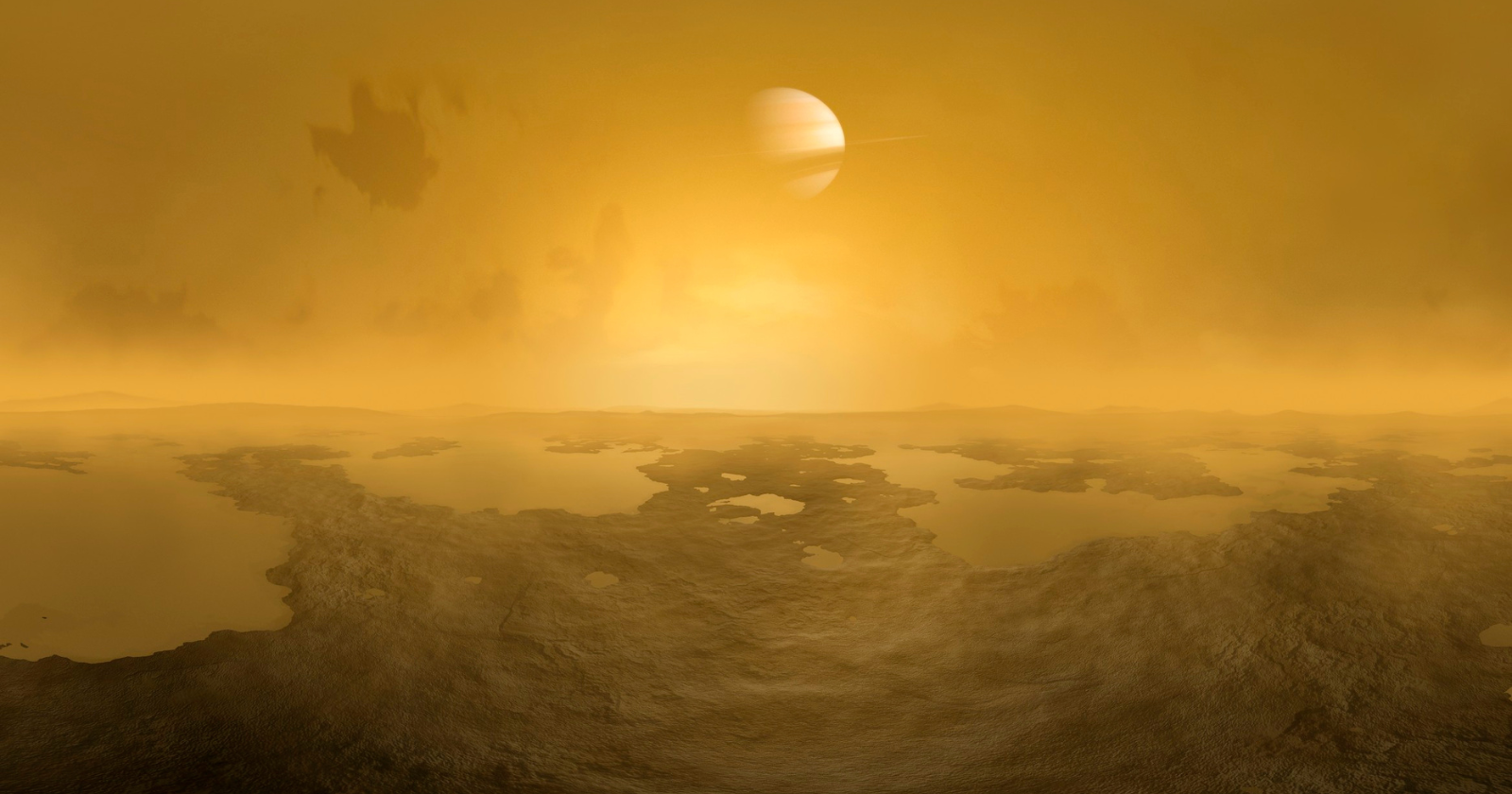
Somewhere out at Saturn, right now, it is drizzling on a shoreline.
The rain is falling out of orange clouds, slowly — drifting down more like snowflakes than raindrops. It’s collecting into streams, and the streams are cutting channels through solid bedrock, and the channels are draining into a sea bigger than the Caspian. There are rounded pebbles on the ground, tumbled smooth by running liquid, exactly like the ones in any creek you’ve ever waded.
This is Titan, Saturn’s largest moon, and it is the only world we know of besides Earth where liquid falls from the sky, flows across the surface, and pools into standing seas. The catch — the thing that makes Titan the strangest familiar place in the solar system — is that the entire system is built from the wrong materials. The rain is methane. The seas are methane and ethane. And the rock those rivers carve through is water, frozen at minus 179 degrees Celsius into something harder than most stone on Earth.
It’s our landscape, run on a different chemistry set. And the closer you look, the more uncanny the copy gets.
The rain that falls like snow
Start with the weather, because Titan genuinely has weather — clouds that build, storms that break, rainfall that darkens the ground and then dries.
The working fluid is methane, the same molecule burning in a gas stove, which at Titan’s temperatures behaves the way water behaves here: evaporating from the seas, condensing into clouds, and falling back out as rain. The European Space Agency describes it plainly: Titan’s lakes and atmosphere form an active hydrological cycle — the first ever found running on a liquid other than water.
But the rain itself would look wrong to Earth eyes. Titan’s gravity is about one-seventh of ours and its atmosphere is half again denser at the surface, so methane raindrops grow large and then fall in slow motion — descending at roughly the pace of falling snow. A Titan rainstorm is a heavy, unhurried thing: fat drops sinking through orange haze onto a frozen plain, gentle as a blizzard and flammable only in a world with oxygen, which Titan mercifully is not.
Rivers with familiar manners
Follow the rain downhill and Titan keeps doing Earth impressions.
Cassini’s radar mapped branching river networks that would pass for aerial photos of Appalachia — tributaries gathering into trunks, valleys incised into highlands, channels meandering toward coastlines. One mapped river, Vid Flumina, runs into the sea Ligeia Mare like a hydrocarbon Mississippi reaching its gulf. When the Huygens probe descended in 2005, it photographed drainage channels on the way down and then landed on a floodplain scattered with rounded cobbles — pebbles of water ice, tumbled smooth by episodic methane floods, obeying the same fluvial physics that rounds granite in a trout stream.
That’s the quietly astonishing part: the physics doesn’t care about the chemistry. Give any world a liquid, a slope, and time, and it will draw the same shapes — dendritic channels, deltas, shorelines, floodplains. Titan is the proof: a second, independent run of the experiment called “landscape,” and it converged on answers a hiker would recognize.
Seas the size of ours, with lakes that shouldn’t exist
At the end of the rivers wait the seas — clustered, for reasons still debated, around Titan’s north pole.
Kraken Mare, the largest, covers more area than the Caspian Sea, with parts plausibly hundreds of meters deep. Ligeia Mare, next door and connected to it, was sounded by Cassini’s radar at about 160 meters along one track — the radar signal passing clean through the methane and bouncing off the seafloor, something it could never do through an equivalent depth of seawater.
And on Cassini’s final Titan flyby, the mission saved one last surprise: the small lakes of the north turn out to be perched on hills and mesas, more than 100 meters deep, their basins apparently formed when the surrounding bedrock chemically dissolved and collapsed — the same karst process that makes sinkhole lakes in Florida and Croatia, except the “limestone” dissolving on Titan is ice and solid organics. The same flyby found transient lakes: shallow ponds that filled and vanished between observations, seepage and evaporation trading liquid back and forth with the ground.
Rain, rivers, karst country, seasonal ponds. Somewhere in the outer solar system, nine hundred million miles from the nearest umbrella, hydrology is just… happening.
The bedrock is the punchline
Here’s the detail that reorganizes the whole picture once it lands: on Titan, water never gets to be water.
At 94 kelvin, H2O isn’t rain and isn’t sea — it’s geology. Titan’s crust is water ice frozen so profoundly cold that it’s a load-bearing solid with the strength of rock: mountains of ice, boulders of ice, cliffs and canyons of ice. When the methane rivers erode their valleys, ice is the granite they’re cutting. When waves work a shoreline, ice is the headland they’re wearing down.
Which means Titan contains a perfect inversion of home. Earth’s cycle: water moves, rock stands still. Titan’s cycle: the rock is the water, standing still, while a gas from your kitchen stove does all the moving. Every role in the play is filled — rain, river, sea, stone — but the actors have swapped costumes. And the play still works. It has run, as far as anyone can tell, for a very long time: Titan’s seasons each last about seven Earth years, so a single hydrological year there stretches across three decades, a cycle turning with the patience of a world that has nowhere to be.
The dragonfly that will land in the rain country
The reason to remember all this now: we’re going back, and this time we’re bringing something that flies.
NASA’s Dragonfly mission — a car-sized nuclear-powered rotorcraft — is slated to launch in 2028 and arrive in the mid-2030s, exploiting the same thick-atmosphere, low-gravity combination that slows Titan’s rain to make powered flight almost easy. It will hop from site to site across the equatorial dunes (which are themselves made of organic sand, because of course they are), sampling the ice bedrock and the fallout of the methane cycle, hunting for the complex carbon chemistry that a world of hydrocarbons and water ice can’t help but brew.
Because that’s the deepest reason Titan’s familiar landscape matters. Everywhere on Earth that water meets rock and weather, chemistry happens — and eventually, at least once, that chemistry woke up. Titan is the only other place we know where a working weather cycle has been grinding liquid against land for eons, running the same slow experiment with a different ingredient list.
The rivers look like ours. The question Dragonfly carries is whether anything else does.
Until then, the drizzle continues on that distant shoreline — patient, orange-lit, minus 179 degrees — on the only other world in the solar system where you could stand and watch it rain.
