On a wind-scoured ridge in California’s White Mountains, a Great Basin bristlecone pine called Methuselah is still producing needles after almost five millennia. A 2026 reference-genome paper lists its age as 4,857 years in 2025, which places its germination at roughly 2833 BCE.
That means Methuselah was already growing when construction of the Great Pyramid of Giza began around 2560 BCE. It would have been approximately 270 years old at the time, not a millennium old, but it has remained alive through the rise and fall of Egyptian dynasties, Rome, Tang China, the Mongol and Ottoman empires, and the colonial era in the Americas.
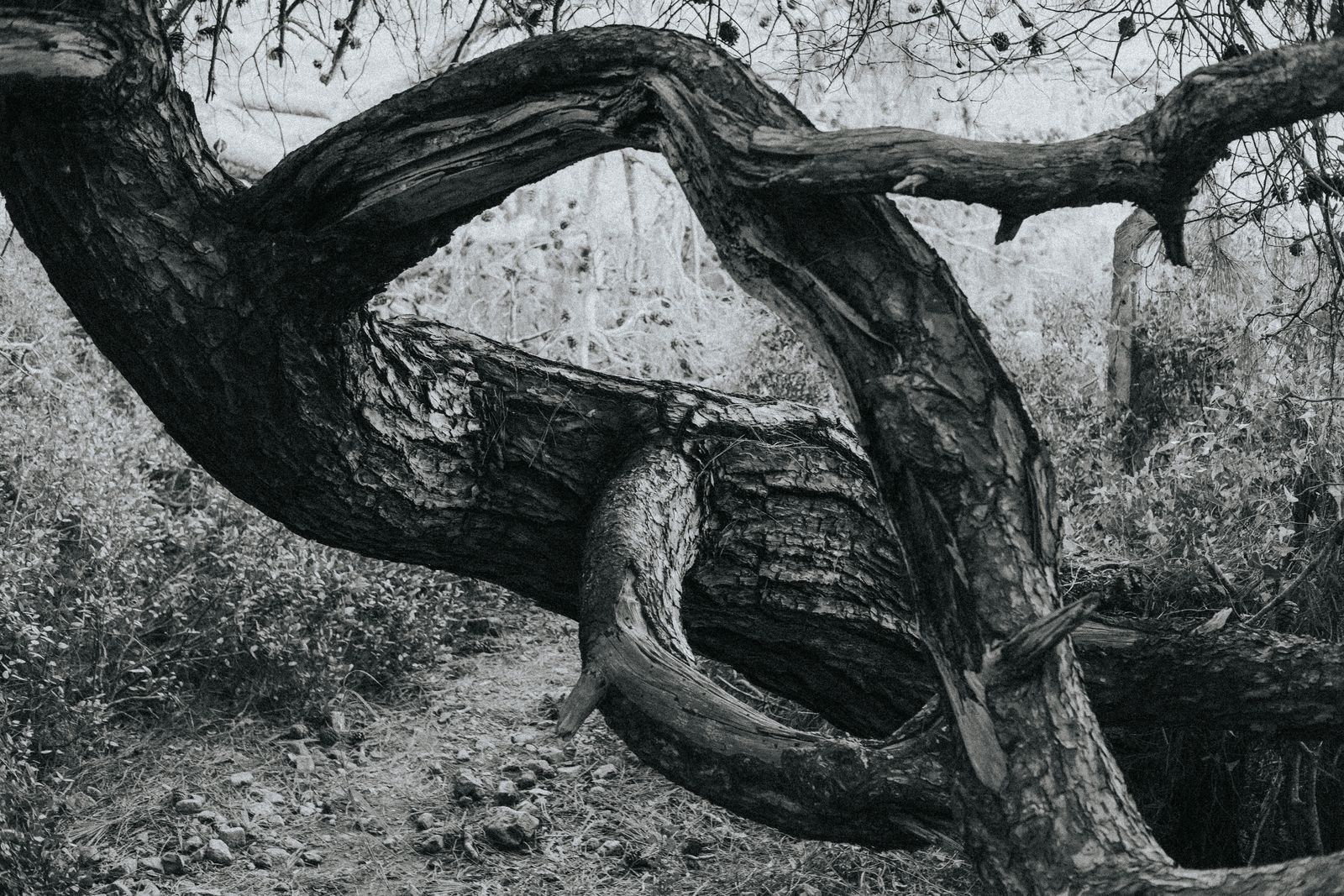
The tree does not resemble a towering sequoia. Much of its trunk consists of dead wood bleached and sculpted by wind, ice and blowing grit, while narrow living sections continue connecting roots to green branches.
A tree that survives by refusing to hurry
Great Basin bristlecone pines, Pinus longaeva, are native to high mountains in eastern California, Nevada and Utah. In the White Mountains they grow near the forest’s dry margins, where the growing season is short, the wind is severe and carbonate soils restrict many competing plants.
Slow growth is part of their survival strategy. The National Park Service explains that this growth produces exceptionally dense wood resistant to insects, fungi, rot and erosion.
The wood is also rich in resin, while the needles can remain functional for decades. Retaining needles reduces the resources required to replace foliage in an environment where favorable growing seasons are brief and unpredictable.
Dead wood and living sectors
An ancient bristlecone can appear mostly dead without being close to biological death. Its vascular system has a sectored architecture in which particular roots support the portions of the tree directly above them.
If erosion or injury kills one root, the corresponding section of trunk and crown may die while another sector continues functioning. The resin-rich dead wood can then remain standing for centuries, gradually polished rather than rapidly decomposed.
This partial dieback helps explain the trees’ skeletal appearance. Sparse vegetation around the oldest high-elevation specimens also limits competition and reduces the amount of fuel through which a forest fire could approach them.
How Edmund Schulman documented the ancient grove
Dendrochronologist Edmund Schulman of the University of Arizona spent years searching the American West for exceptionally old trees. In the 1950s he began systematically sampling bristlecones in the White Mountains with increment borers, which extract narrow cores without requiring a tree to be felled.
Schulman described the discovery in a March 1958 National Geographic article. At the time, he reported that the oldest specimen he had examined had begun growing more than 4,600 years earlier.
Later cross-dating extended Methuselah’s documented age, with the 2026 genome paper giving 4,857 years for 2025. The tree is commonly described as the oldest confirmed living non-clonal tree, although other provisional age claims complicate any absolute record.
Methuselah grows within Inyo National Forest, but the individual tree is not identified for visitors. The Methuselah Trail passes through its grove without a sign revealing which ancient pine carries the name.
The Prometheus lesson
The need to protect ancient trees is underscored by what happened in Nevada in 1964. Donald Rusk Currey, then conducting research on Ice Age glaciology near Wheeler Peak, had Forest Service permission to take samples from local bristlecones.
Accounts differ over why one tree was felled. According to the National Park Service’s Prometheus history, Currey’s borer may have become stuck or proved too short, or he may have concluded that he needed a complete cross-section.
What is certain is that the Forest Service authorized the cutting. A later count found 4,862 growth rings, and missing rings associated with harsh growing conditions led researchers to estimate the tree’s age at approximately 4,900 years.
Prometheus became a lasting conservation lesson because its significance was understood only after it had been cut. Bristlecone pines on federal land are now protected, and the surviving stump and a cross-section preserve part of the tree’s scientific record.
What a 23.8-billion-base-pair genome revealed
In March 2026, researchers coordinated by the University of California, Davis and Johns Hopkins University published a reference genome for Pinus longaeva in G3: Genes|Genomes|Genetics. The assembly contains approximately 23.8 billion base pairs, close to eight times the size of the human genome.
The sample did not come from Methuselah. Researchers collected needles and seeds from a different White Mountains bristlecone estimated to be approximately 2,500 years old.
The researchers examined two proposed explanations for extreme longevity: disease-resistance genes called NLRs and comparatively long telomeres. Their results were more cautious than the early headlines surrounding the project.
The bristlecone did not have an unusually high number of NLR genes compared with the other conifers examined. Its estimated telomeres were longer than those of several long-lived conifers but shorter than those of the much shorter-lived loblolly pine, so the paper concluded that neither feature showed strong evidence of explaining exceptional longevity.
Co-author Steven Salzberg, a Johns Hopkins professor of biomedical engineering, emphasized the technical challenge of assembling such a large genome. He noted that it contains only slightly more protein-coding genes than the human genome, with much of the remaining sequence consisting of millions of repetitive elements sometimes described as “junk DNA.”
Project lead David Neale, a UC Davis professor emeritus of plant sciences, described the reference sequence as a parts list rather than the discovery of a longevity gene. As the UC Davis account of the project explains, sequencing one tree does not by itself reveal the genetic basis of its long life, but it gives future researchers a resource against which new questions can be tested.
Do bristlecones age at all?
The genome project also renewed interest in whether bristlecones undergo senescence in the same way many animals do. Their sectored growth allows one portion to die while another remains active, and old trees often succumb to external damage or environmental stress rather than an obvious age limit.
That observation is not proof that a bristlecone could live forever. Neale explicitly cautioned that the idea is overstated, while acknowledging that a tree capable of surviving for nearly 5,000 years naturally raises questions about how biological aging works.
Older claimants and uncertain records
Methuselah’s record depends on what counts as confirmed. The 2026 genome paper mentions another White Mountains bristlecone provisionally dated in 2012 at 5,065 years old, but it describes that age as unconfirmed.
In Chile, a Patagonian cypress called Gran Abuelo has also been proposed as an older candidate. Environmental scientist Jonathan Barichivich and collaborator Antonio Lara counted 2,400 rings in a partial core and used statistical modeling to estimate a probable age of 5,484 years.
The reported model gave Gran Abuelo an 80 percent probability of being more than 5,000 years old. Because the estimate did not come from a complete, cross-dated series of rings, other dendrochronologists have not treated it as a confirmed replacement for Methuselah.
The careful formulation is therefore that Methuselah remains one of the oldest confirmed living non-clonal trees and the best-known named record holder. It cannot establish that no older, undated individual exists.
What survived alongside the tree
When Methuselah germinated around 2833 BCE, writing and the wheel had already existed for centuries. The Great Pyramid had not yet been built, and the major construction phases at Stonehenge were still unfolding.
When the Iliad took shape in ancient Greece, the tree was already roughly two millennia old. It was approaching 2,800 years when Julius Caesar crossed the Rubicon in 49 BCE.
By the time construction of Notre-Dame in Paris began in the 12th century, Methuselah was nearly 4,000 years old. When Gutenberg’s printing work transformed Europe in the 15th century, the tree had been growing for more than 4,200 years.
Those comparisons are approximations because the dates of ancient cultural events are themselves sometimes debated. They nevertheless convey the central fact accurately: one living organism has persisted while dynasties, empires, technologies and languages repeatedly emerged and disappeared.
The threat the tree has not seen before
Longevity does not make the species immune to environmental change. A 2022 Forest Service study documented unexpected bristlecone mortality at two sites and investigated the combined roles of warming, moisture stress and bark beetles.
At both sites, temperature and climatic water deficit increased during the 2010s, with the highest water deficit in the study’s 40-year record occurring in 2020. Researchers also found bark-beetle attacks between 2013 and 2020, particularly where other pine species capable of sustaining beetle populations grew nearby.
The same study cautioned that Great Basin bristlecones remain poor hosts for reproducing beetle populations. The findings therefore identify an emerging risk under particular conditions, not a universal bark-beetle collapse across the species’ range.
Constance Millar, an ecologist with the USDA Forest Service’s Pacific Southwest Research Station and a co-author of the genome paper, has emphasized that White Mountains populations persisted through climate extremes for almost 11,000 years. That history demonstrates resilience, but it does not guarantee that every population or seedling will withstand rapid future change.
The reference genome gives land managers a new tool for studying genetic variation associated with adaptation to heat, drought and other environmental pressures. Its immediate value is not a single longevity gene, but a foundation for comparing trees and populations across the species’ range.
A slower kind of witness
Ancient plant life often persists in places that shelter it from faster-growing competitors and repeated disturbance. The 1994 rediscovery of Wollemi pines in a secluded sandstone gorge west of Sydney offers another example, although the biology and history of that species are very different.
Bristlecones endured by growing slowly in cold, dry and nutrient-poor terrain. Dense resinous wood resists decay, long-lived needles conserve resources, and sectored growth permits part of a tree to survive when another part fails.
Somewhere along the Methuselah Trail, a narrow living strip is still moving water and sugars between roots and green branches. The tree carries no record of pyramids or empires except the years preserved in its wood, and in a particularly harsh season it may add almost no visible growth at all.
That restraint is the point. Methuselah has remained alive not through uninterrupted strength, but through nearly five millennia of making only as much growth as the mountain allowed.