

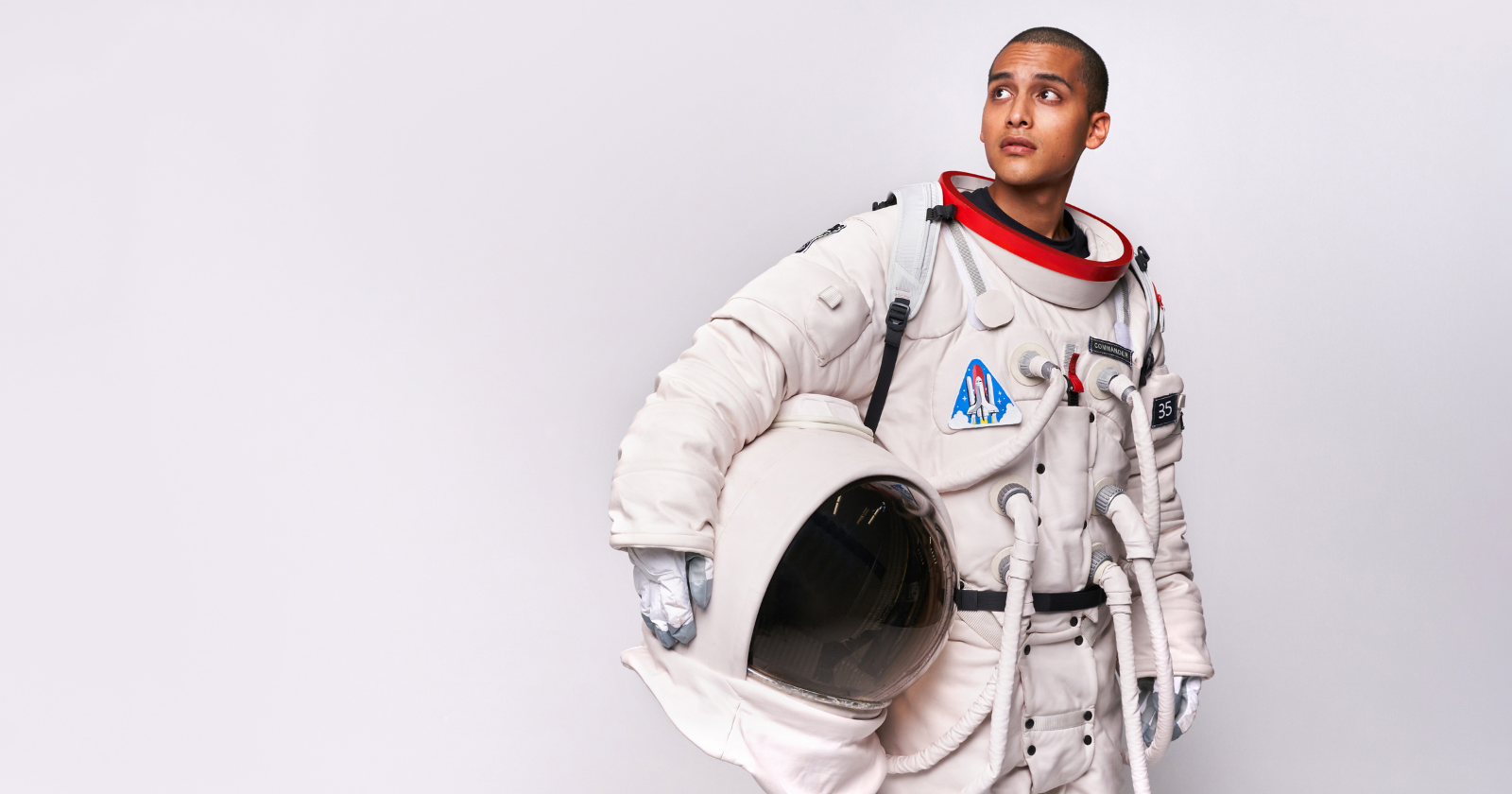
The hardest part of a six-month space mission, according to the people who’ve flown them, isn’t the launch. It isn’t the confinement, or the recycled air, or the two hundred sunrises a week.
It’s the part nobody films: the weeks after landing, when the astronaut is home, healthy, celebrated — and quietly not quite there. Sitting at their own kitchen table like a guest. Walking their own street like someone reviewing footage of it. Present at their life, but a half-step outside the frame of it.
There’s no official name for this. It isn’t a diagnosis, and you won’t find it as a line item in a flight surgeon’s checklist. But listen to enough returning crew members describe their first month back on Earth and the accounts start to rhyme — and the research on what reentry does to a human being suggests the rhyme is no accident.
Coming back is the harder trip
Start with what’s actually documented, because the documented part is strange enough.
Researchers who study long-duration spaceflight have found that returning crew members commonly experience fatigue, dizziness, and emotional disturbance during the re-adaptation phase — a period in which the body must consciously relearn things it once did automatically. After months in microgravity, walking requires deliberate attention. Balance is a negotiation. The inner ear, which spent half a year filing gravity under “optional,” floods the brain with error messages.
Scott Kelly, who spent 340 days aboard the ISS, has been blunt in his public accounts that the return was in many ways more punishing than the mission — the body’s protest at Earth lasting long after the capsule stopped steaming. NASA’s medical teams expect this. The physical curve is mapped: vestibular chaos in the first days, cardiovascular and muscular reconditioning over weeks and months.
But threaded through the physical accounts is something the checklists capture less well — a perceptual strangeness. When your own legs require supervision, when a shower’s water pressure feels like an event, the ordinary world stops being transparent. You don’t live in it. You operate it. And operating your life is a different experience from being inside it.
The distance that isn’t on the scans
Here’s where the psychology research picks up the thread.
Studies of astronaut readjustment describe a specific emotional geometry on return: a psychological distance between the returning individual and the society they came back to. The world hasn’t changed — but the astronaut’s perspective has, radically, and the mismatch leaves them feeling alienated inside their own former routines. Deadlines, small talk, traffic: all of it still runs, and the returning crew member watches it run with the mild bafflement of an anthropologist embedded in their own family.
Psychologists studying this have long noted the pattern isn’t unique to space. Researchers compared astronaut reentry to polar expeditioners and military personnel returning from deployment — people coming back from months in sealed, high-structure worlds where everyone around them shared one reality. In all three groups, the same struggle appears: reconnecting emotionally with an environment that used to be home and now feels like a set of it.
That’s the honest shape of the “observer” feeling. Not a syndrome. A gap — between a self that was recalibrated by an extreme world and an ordinary world that kept the old settings.
Why the brain goes spectator
Pull the mechanisms apart and the half-step-outside sensation starts to look almost inevitable.
A brain in orbit spends six months rebuilding its most basic models: which way is down, what a body weighs, what a day is when the sun rises sixteen times in one. Those models aren’t opinions — they’re the invisible scaffolding underneath the feeling of being here. Presence, the effortless kind, is what it feels like when your predictive models match reality so well you stop noticing them.
Reentry breaks the match. Suddenly every model is wrong at once — gravity, balance, distance, even the taste of food — and the brain has to fall back on manual mode, checking its own outputs like a pilot flying on instruments. From the inside, that constant self-monitoring has a signature texture: you, watching you. The observer isn’t a mystical add-on. It’s what consciousness feels like while its autopilot is in the shop.
Layer on the perspective shift — many astronauts describe a lasting reorientation after seeing Earth whole, the experience writer Frank White famously called the overview effect — and the frame widens further. It’s hard to stand in a grocery store queue as if the queue is the universe when you have recently seen the actual universe, with the queue in it.
It fades — and what fading means
The reassuring part, borne out by the readjustment research: the distance closes. Crews are supported through structured debriefs and family preparation precisely because agencies know the first months home are their own mission phase. The models retrain. Walking becomes walking again. The astronaut stops operating their life and slides back inside it — usually.
But talk to those who’ve been through it and you’ll hear a note of ambivalence about the fading, because the observer, for all its loneliness, saw clearly. From the half-step back, the astronaut could see their routines as choices, their irritations as small, their days as astonishing and countable. Full reimmersion returns comfort — and takes the clarity as payment. More than one returning crew member has described working, deliberately, to keep a little of the distance: the ability to occasionally step out of the frame on purpose, rather than never again.
The version of this that happens to you
You will probably never spend six months in orbit. But you’ve touched the edge of this state, because milder versions of the same mechanism fire down here.
Come home from months abroad, a long deployment, a hospital stay, even an all-consuming project, and the first days back have that same faint unreality — your kitchen briefly a museum exhibit of your life. Same cause, smaller dose: your models updated somewhere else, and home hasn’t caught up.
The astronauts just get the maximum-strength version, and with it, the maximum-strength lesson: being present in your life is not a given. It’s a construction — one your brain rebuilds so quietly and so well that you can go decades without noticing it’s built at all.
Until you leave far enough, for long enough, and come back to find the scaffolding visible.
Then you spend a few strange weeks watching yourself live — and you understand, in a way no one on the ground quite can, that the ordinary feeling of simply being here was the rarest view of the whole trip.
