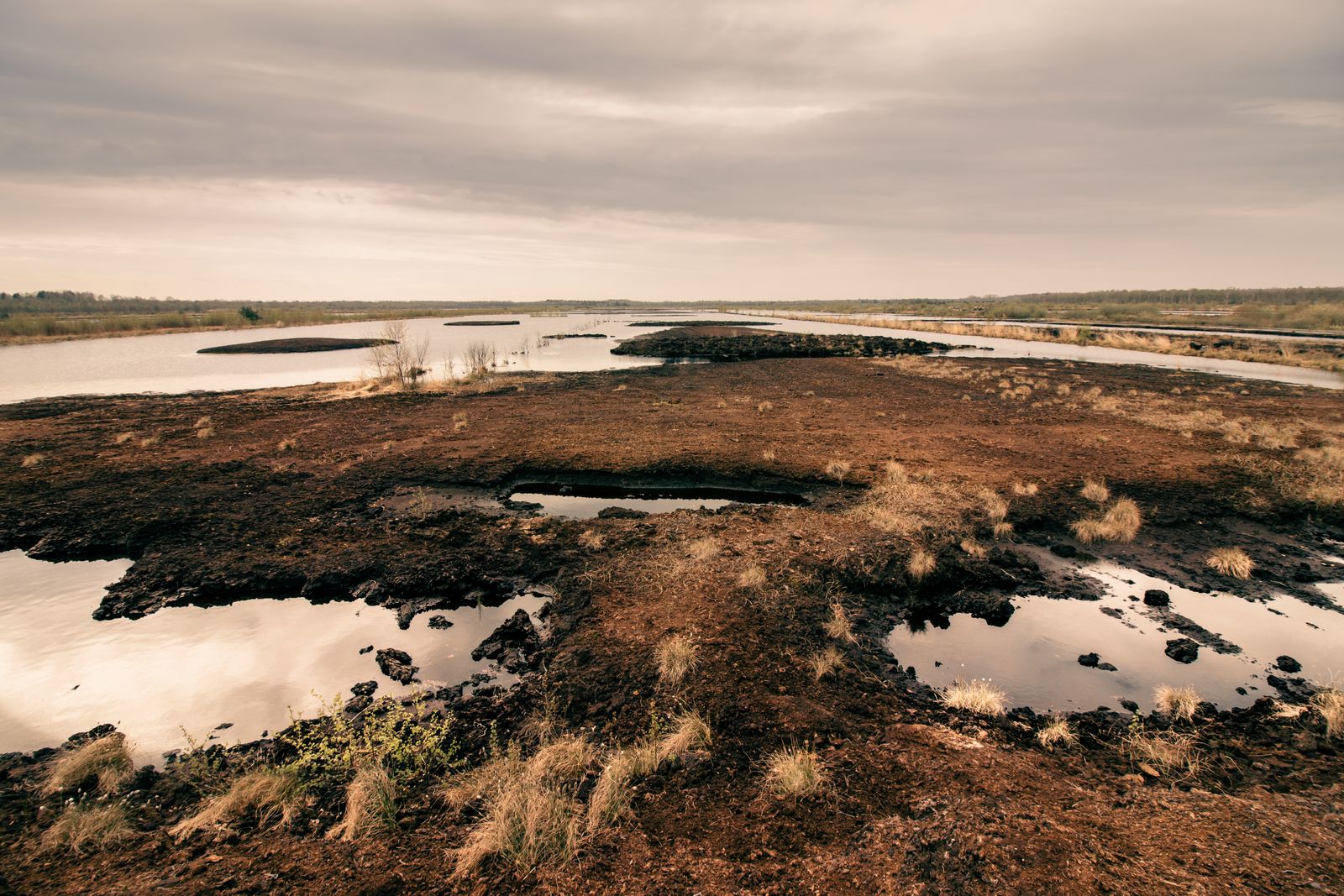
Peat is the answer. Drainage lowers the water table and lets oxygen into an enormous store of partly decomposed plant material, allowing microbes to turn that stored carbon into greenhouse gases year after year.
A Malaysian peat-swamp field study measured about 1,596 megagrams of carbon per hectare in peat soil versus about 153 megagrams in above-ground biomass, while a separate oil-palm conversion study estimated 70 to 117 tonnes of CO2-equivalent emissions per hectare per year. The headline comparison is therefore cumulative: repeated losses from the soil can overtake the finite carbon pulse from clearing the trees above it.
That distinction matters. The defensible comparison is not one year of drainage versus one act of forest clearing, but a large underground carbon reservoir being exposed to oxidation for years or decades after the above-ground forest carbon has already been lost.
What peat actually is
Peat is plant material that accumulated faster than microbes could completely decompose it. In a waterlogged forest, saturated soil restricts oxygen, slowing decay and allowing leaves, roots and wood to build into an organic deposit over centuries or millennia.
The UN Environment Programme estimates that peatlands cover only about 3 to 4% of the planet’s land surface yet contain as much as one-third of the world’s soil carbon. That is roughly twice the carbon stored in all forest biomass.
The water is what keeps that carbon bank intact. Drying, whether through deliberate drainage or severe drought, changes the chemistry of the upper peat, which is why carbon loss can accelerate when peatlands dry.
The size of the underground store can dwarf what is standing above it. A North Selangor study found peat carbon stocks of about 975 megagrams of carbon per hectare in secondary forest and about 497 in mature oil-palm plantations, alongside chemical evidence of enhanced decomposition after conversion.
Why drainage is the trigger
Oil palm cannot be grown conventionally on deeply waterlogged peat without changing its hydrology. Plantation drainage canals lower the water table so roots, roads and machinery can function on ground that would otherwise remain saturated.
Once the water table falls, oxygen penetrates the newly exposed peat. Aerobic microbes can then break down organic matter far faster than they could under anoxic conditions, turning carbon accumulated over very long periods into carbon dioxide.
Measurements across the conversion of Malaysian peat-swamp forest to oil palm put the full greenhouse-gas emission factor at 70 to 117 tonnes of CO2 equivalent per hectare per year. Carbon dioxide accounted for about 60% of that total and nitrous oxide about 40%, showing that peat oxidation is not the only greenhouse-gas process triggered by the conversion.
For carbon dioxide alone, the same study estimated an average loss of about 53 tonnes of CO2 per hectare per year across a 30-year plantation cycle. Those figures do not support the claim that a single year of drainage releases more carbon than the entire forest canopy once held.
What they do support is more consequential over time. Clearing removes a large but finite above-ground carbon stock, while drainage creates a recurring soil source that continues as long as enough peat remains aerated.
The methane problem in the ditches
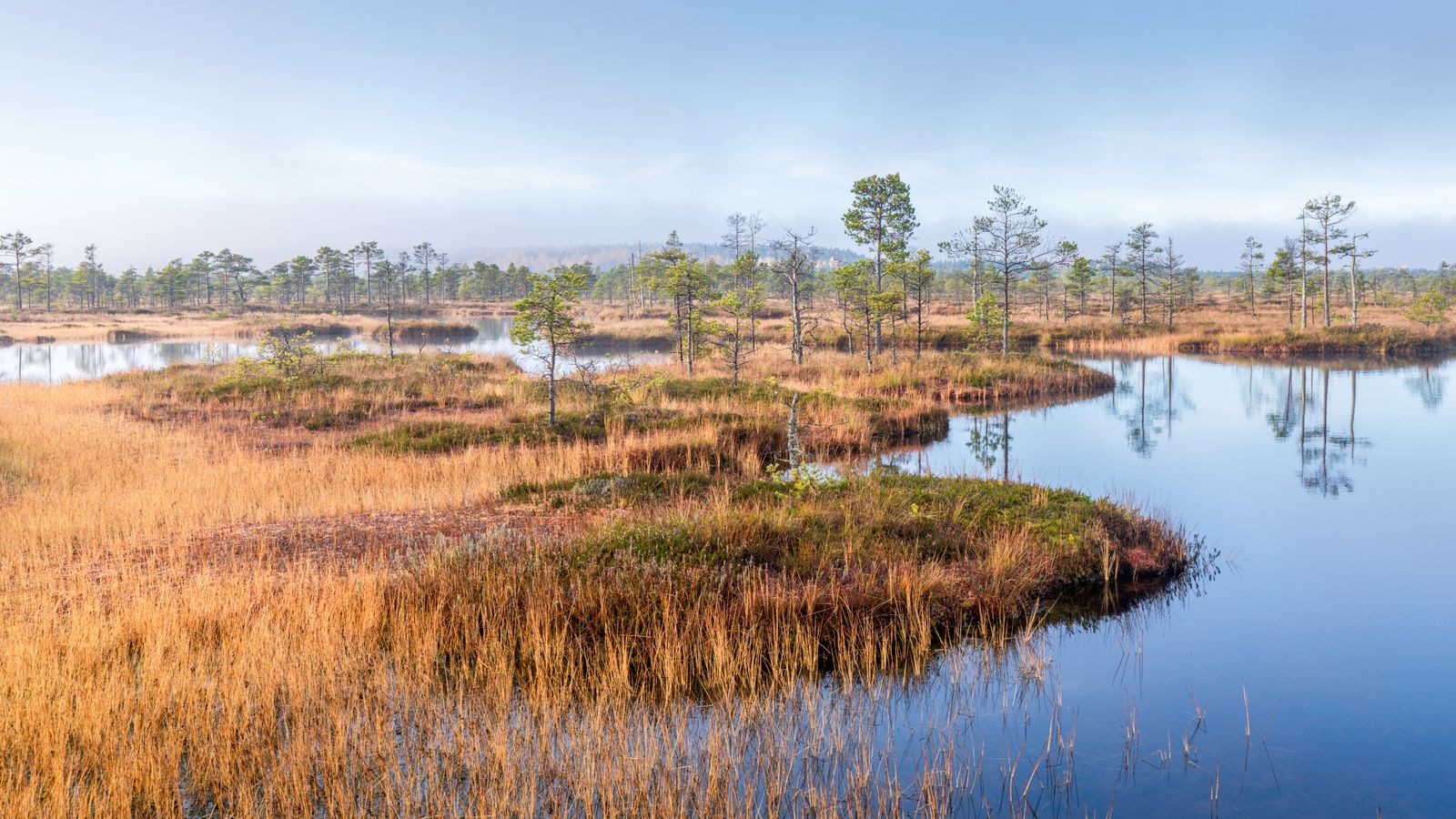
The drained soil surface generally becomes a stronger source of carbon dioxide and a weaker source of methane. The canals themselves can behave differently because they contain stagnant, oxygen-poor water over decomposing organic material.
A 2025 Scientific Reports study of oil-palm drainage ditches in Sarawak sampled two plantation sites during the transition between drier and wetter conditions. It was a spatial sampling campaign rather than a two-year continuous field study, an important distinction because the authors explicitly called for longer-term measurements.
Free water in the ditches covered only about 3.6% of a hectare, yet the researchers estimated that ditch emissions could contribute about 4% of annual plantation greenhouse-gas emissions in a first-rotation plantation and about 10% in a second-rotation plantation.
Methane bubbling, or ebullition, was a major part of the flux. That matters because irregular bursts can be missed by measurements designed to capture only steady diffusion from the water surface.
The climate effect is also disproportionate to the mass released. The US Environmental Protection Agency lists methane as roughly 81 to 83 times more powerful than CO2 over 20 years, and roughly 27 to 30 times more powerful over 100 years.
Adding up the emissions across decades
The scale of the underground reservoir explains how the arithmetic eventually tips. The Selangor field measurements of about 153 megagrams of carbon per hectare in above-ground forest biomass correspond to roughly 561 tonnes of CO2 if every tonne of that carbon ultimately reached the atmosphere.
The peat beneath the same forest contained about 1,596 megagrams of carbon per hectare, equivalent to roughly 5,850 tonnes of CO2 if it were all oxidized. That is not a prediction that the entire peat column will disappear, but it shows why sustained losses from only part of the soil can rival or exceed the carbon contained in the trees.
The oil-palm flux measurements put that process on a timescale. At an average peat-derived CO2 loss near 53 tonnes per hectare per year, years of continued oxidation can accumulate into a carbon release far larger than a one-off biomass pulse.
This is also why the comparison should not be generalized to every tropical peat land use. In shallow peat forests converted to water-buffalo pasture in the lower Amazon, researchers found that 62% of measured ecosystem carbon loss was attributable to declines in above-ground vegetation. Peat depth, hydrology and land use determine which side of the ledger dominates.
Why putting the water back is complicated
The obvious response to peat oxidation is to raise the water table again. Restoring saturation reduces the volume of soil exposed to oxygen, although it can simultaneously create better conditions for methane-producing microbes.
That tension appears across wetland restoration, where changes in the water table can reshape the carbon balance. The exact greenhouse-gas result depends on vegetation, temperature, nutrient supply and how high the water is raised.
A two-year mesocosm experiment published in 2026 illustrates the trade-off. When researchers shifted lowland agricultural peat from saturation to a water table 20 centimetres below the surface, methane emissions fell by more than 90%, while carbon dioxide increased; expressed as CO2 equivalents, total emissions were 27 to 35% lower under the moderately drained treatment.
The same experiment found that biochar reduced cumulative CO2 emissions by as much as 52% over 730 days, while cereal straw and biosolids could stimulate greenhouse-gas losses. It was a controlled experiment using temperate lowland peat, not a prescription for tropical oil-palm plantations, but it shows why water level alone cannot describe the entire greenhouse-gas balance.

The vault, once opened
The physical landscape records the loss. A satellite study covering 2.7 million hectares of Southeast Asian peatland found that more than 90% of the surveyed area was subsiding, at an average rate of about 2.2 centimetres per year.
Subsidence is produced by more than oxidation alone, especially soon after drainage when peat can compact, but over time it is also a visible consequence of carbon-rich organic matter being decomposed and lost from the soil.
That is the asymmetry hidden beneath a peat-swamp forest. The trees may contain hundreds of tonnes of carbon per hectare, but the soaked soil below them can contain thousands.
Cutting the forest empties part of the account quickly. Cutting the drainage canals changes the conditions inside the vault itself, and the ground can keep sinking centimetre by centimetre while carbon assembled over centuries and millennia leaves as invisible gas.