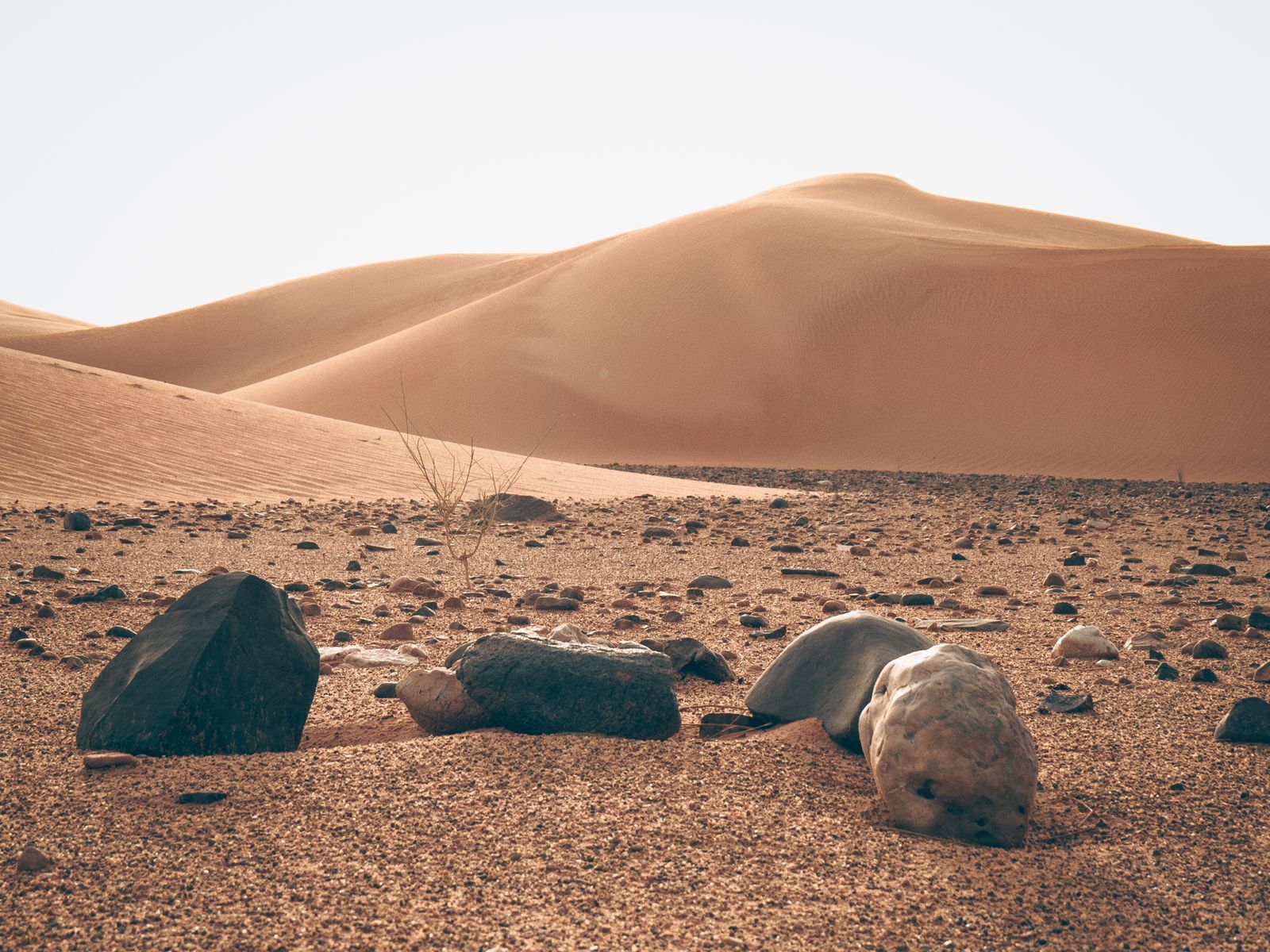
Every year, a river of pulverised rock lifts off the Sahara, climbs a mile into the sky, and rides the trade winds across the Atlantic. When it comes down on the other side, it lands on the poorest soils of the largest rainforest on Earth. NASA’s CALIPSO satellite, using a space-based lidar that scanned the atmosphere from 2007 to 2013, measured the traffic: on average 182 million tonnes of dust lift off West Africa each year, and roughly 27.7 million tonnes of it settle onto the Amazon basin. That Amazon-bound fraction carries about 22,000 tonnes of phosphorus — almost exactly the amount the rainforest loses to rain and flooding every year.
The mechanism has a name, a source, and a strange geological coincidence at its heart. The dust rides in the Saharan Air Layer, a hot, dry pancake of atmosphere that forms above the cooler marine air each summer. Most of the phosphorus in the plume comes from a single spot: the Bodélé Depression in northern Chad, a dried-out lakebed of ancient freshwater diatoms whose fossilised remains are unusually rich in the nutrient rainforests crave.
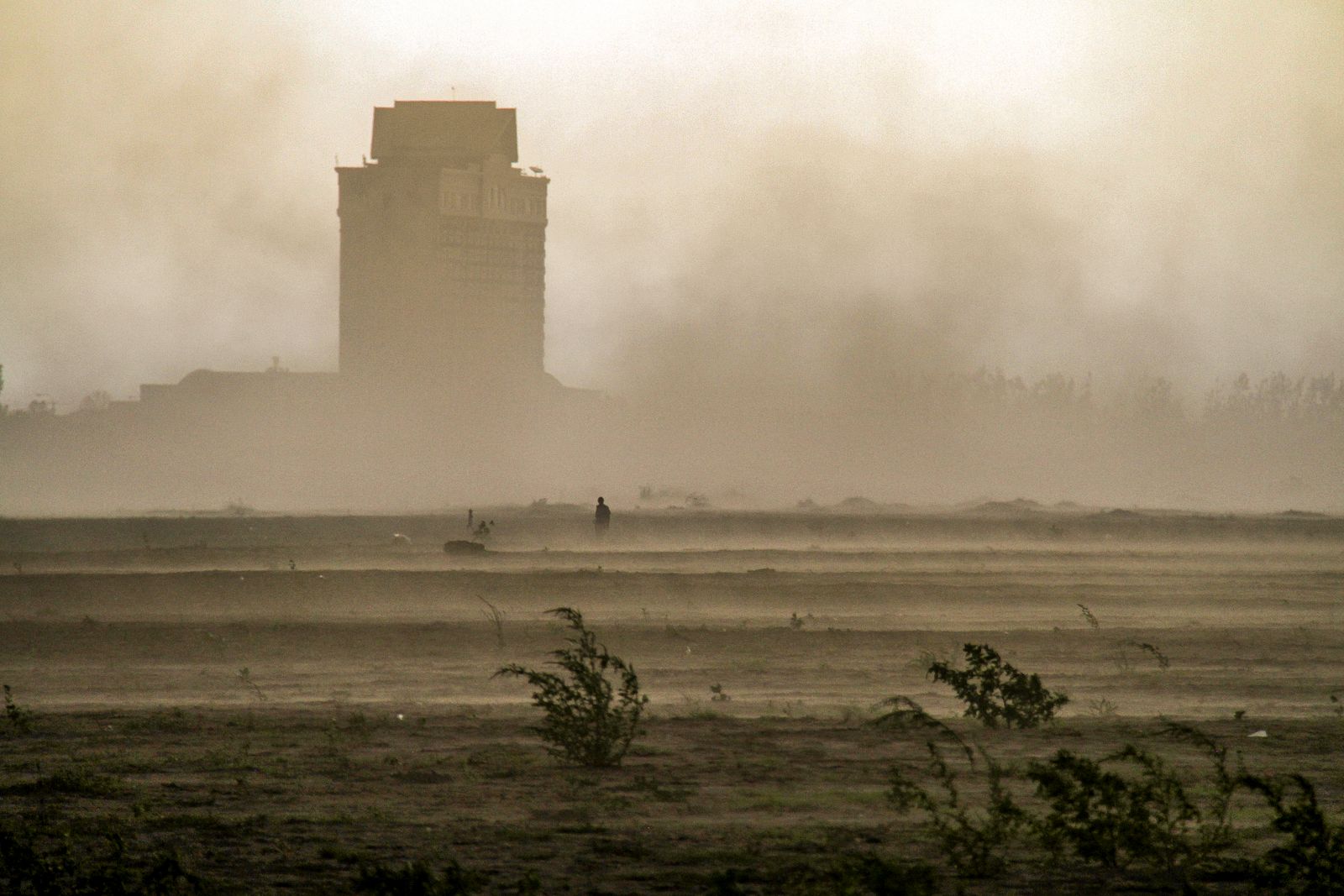
The dust comes from an ancient lake, not a dune
Sand dunes are almost never the source. The grains are too heavy for anything but the fiercest wind to lift. The dust that crosses oceans comes from flats and hollows where water once pooled and left behind fine, mineral-rich sediment.
The Bodélé sits in the low point of what was, about 7,000 years ago, Lake Mega-Chad. At its peak the lake covered more than 400,000 square kilometres — slightly larger than the Caspian Sea, the biggest lake on Earth today. Its old shorelines are still legible in elevation data, hundreds of kilometres out into what is now desert.
When Mega-Chad dried, it left a thick bed of diatomite: the fossil skeletons of microscopic algae that had spent millennia pulling phosphorus out of the water. That sediment now sits exposed in a wind tunnel between two mountain ranges. When the north-easterly harmattan funnels through, it strips off the top layer and hurls it skyward.
The Bodélé is one of the smallest of the Sahara’s major dust sources by area, but it is the most productive by mass — the single spot that supplies most of the mineral dust reaching the Amazon. On a stormy day, satellite instruments can watch the depression exhale a plume visible from geostationary orbit.
Two miles up, a fast-moving conveyor
Once lofted, the particles rise into the Saharan Air Layer, a mass of very dry air that sits between roughly 5,000 and 20,000 feet above the ocean surface. Because the layer is drier and hotter than the marine air below it, the dust floats on top of a stable temperature inversion and resists mixing out. Trade winds then push the whole sheet westward fast enough to carry particles from Africa to the Caribbean in five to seven days.
The grain size shrinks as the plume travels. Off the Canary Islands, most falling particles are under 20 microns — half the width of the smallest speck a naked eye can resolve. By the time the plume reaches the Caribbean, most are under 10 microns, fine enough to be drawn deep into a pair of lungs. The heaviest bits rain out over the eastern Atlantic. The finest ride the whole way.
A pulse of dust leaves the African coast every three to five days between late spring and early autumn. In June and July the pulses are strongest and most organised. The plume that crossed in late June 2026 sat over Puerto Rico and the US Virgin Islands on the 26th, reached South Florida the following day, and hazed Southeast Texas from the 28th through the 30th.
Why the Amazon needs it
The Amazon is the most biologically productive land ecosystem on the planet, and its soils are terrible. Millions of years of heavy rainfall have leached almost every soluble nutrient out of them. Phosphorus, in particular, keeps getting washed downstream toward the Atlantic. The forest’s abundance sits on top of a nutrient deficit that should not, in theory, be able to sustain it.
The gap is roughly 22,000 tonnes of phosphorus a year. That is what a 2015 study led by Hongbin Yu of the University of Maryland and NASA’s Goddard Space Flight Center, published in Geophysical Research Letters, estimated the basin loses to runoff and flooding. It is also, almost exactly, what the Saharan dust delivers. The match is close enough that Yu’s team concluded the imported dust is what keeps the basin from depleting its phosphorus over decades and centuries.
The satellite record also lets researchers watch the plume swing year to year — by as much as 86 percent across the CALIPSO years. Delivery tracks drought in the Sahel: wetter years in West Africa mean more vegetation, less dust lifted, and a leaner year downwind. The Amazon’s nutrient budget is tethered to rainfall patterns on the other side of the ocean.
The forest’s share does not arrive evenly. The summer pulses that make headlines in Miami and Houston mostly track north of the basin and into the Caribbean. The dust that actually settles on the Amazon comes down largely in boreal winter and spring, when the harmattan is blowing and the trade winds sit further south.
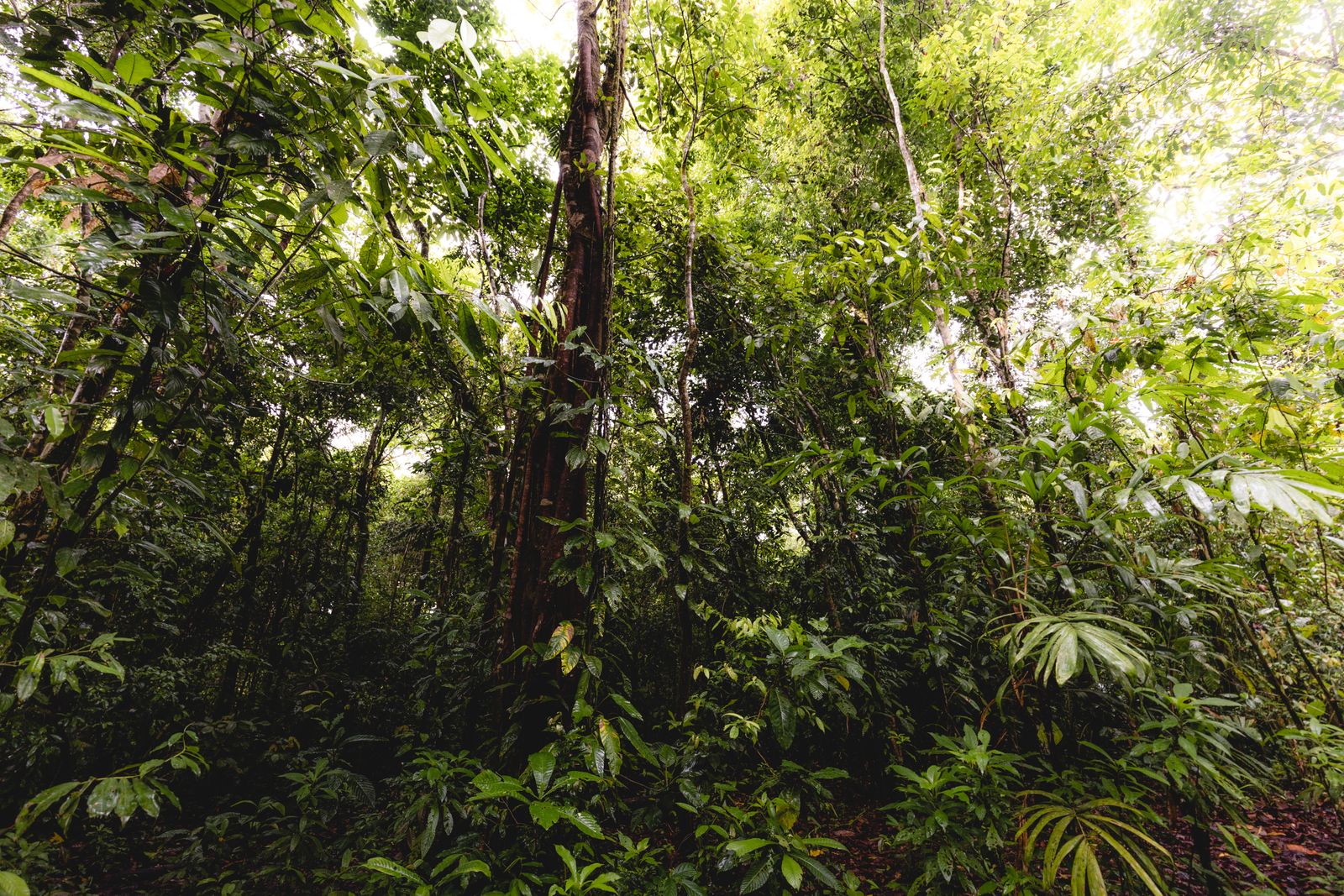
The ocean gets fed, and the storms get starved
Between Africa and South America, the plume rains iron and phosphorus onto the surface of the Atlantic. Phytoplankton — the microscopic photosynthesisers that form the base of the marine food web — are chronically starved for iron in the open ocean. A 2014 study in Nature found that more than 70 percent of the iron available to Atlantic phytoplankton arrives as Saharan dust.
When a plume seeds a bloom, the phytoplankton pull carbon dioxide out of the atmosphere as they photosynthesise. When they die and sink, some of that carbon travels with them to the deep ocean. The effect is powerful enough that dust-driven fertilisation may have accounted for at least a quarter of the atmospheric carbon dioxide change that tipped Earth into the last ice age.
The same particles that irritate lungs in Miami and Houston are, in the middle of the ocean, feeding the organisms behind a large share of the oxygen in every breath.
The layer carrying them does something else on the way across. The Saharan Air Layer is bone dry, and tropical cyclones need warm, humid air rising through a deep column of atmosphere. When a developing storm hits the dust layer, the dry air chokes it, and the fast winds that carry the layer can shear off the top of a growing cyclone.
That is why the strongest dust pulses come during the early hurricane season, when the Atlantic basin is warming but not yet fully primed. This summer the effect has been unusually visible: on 29 July 2026, hurricane specialist Bryan Norcross described a plume “controlling the tropical Atlantic from Africa to the islands”, with El Niño-driven upper-level winds and cool ocean water suppressing what little the dust left alone.
The most extreme case on record was the June 2020 plume that meme-makers nicknamed Godzilla. NASA’s preliminary analysis found a greater concentration of dust over the Atlantic on 20 June than on any other day in the MODIS record going back to 2003; contemporary reporting called it the densest crossing since satellite monitoring began. Air quality across Puerto Rico leapt to hazardous levels as it settled over the island.
What the dust does to human lungs
The particles that feed the Amazon are, at ground level, a public health hazard. In West Africa, downwind of the Bodélé, the dust load is heavy enough to be measurably lethal. A 2020 study in Nature Sustainability, led by Stanford’s Sam Heft-Neal with Jennifer Burney of the University of California, San Diego among its co-authors, combined a million birth records with satellite estimates of particulate matter. An extra 10 micrograms of PM2.5 per cubic metre of air raised infant mortality by 18 percent in West Africa, and by 24 percent across the full sub-Saharan sample.
The burden falls hardest on the countries closest to the source. A recent analysis in Nature Africa examining North Africa’s clean air ambitions noted that dust storms complicate every regional effort to reduce particulate pollution, because a substantial share of the airborne load is not anthropogenic. It is geological, and it is largely unavoidable.
By the time the plume reaches the Caribbean and the southern United States, concentrations have dropped by orders of magnitude. Most healthy people notice only hazier skies and more vivid sunsets. People with asthma or COPD notice more.
A closed loop measured from orbit
The transatlantic dust bridge is one of the clearest examples in Earth science of a single nutrient loop that spans a hemisphere. A dried lakebed in Chad feeds a rainforest in Brazil. The forest’s phosphorus, washed down the Amazon into the Atlantic, is replaced, roughly in kind, by particles from the other side of the ocean. NASA, describing the CALIPSO result, called the Sahara-to-South-America crossing the largest transport of dust on the planet.
The loop is not stable. Natalie Mahowald, a climate scientist at Cornell, has said global dustiness appears to have risen across the 20th century, about half of that from climate change and half from shifting pressure on the land. More recently the trend has bent the other way: North African dust storms have declined at roughly 0.1 storms per month since the mid-1980s, a decline researchers attribute largely to the Atlantic Multidecadal Oscillation. If the Bodélé sees more rain in coming decades, the flux could fall further. The Amazon’s phosphorus supply hangs on the answer.
The trade winds that carry the dust exist because of Earth’s rotation and the temperature gradient between the tropics and the poles. The ocean the dust crosses exists because the Atlantic is still opening. Seismic work published in Nature in January 2021 by Matthew Agius of Roma Tre University and colleagues, using 39 seismometers dropped onto the seafloor, found hints of hot rock welling up from more than 600 kilometres down beneath the Mid-Atlantic Ridge, suggesting the seafloor between Africa and South America is being actively pushed apart from deep in the mantle.
The two continents are drifting apart by a few centimetres a year. The dust crosses the widening gap in under a week. On the geological clock, the plume is racing across a rift that opened only yesterday.
Spacewar has looked at similar long-loop restorations elsewhere — the way a single family of beavers can raise a drought-cracked water table, or how Iceland is clawing its birch forest back tree by tree. The Sahara-to-Amazon loop is bigger by every measure. It runs on wind. It has been running for at least the whole of human evolution, and probably much longer.
As of this week, forecast models show another pulse drifting westward across the tropical Atlantic. It will thin as it goes. Most of it will fall into the ocean, and most of what survives the crossing will veer north toward the islands rather than south toward the trees.
The forest’s delivery comes later, in the dry months at the turn of the year. Somewhere in the Amazon basin, a fine grey film will settle on leaves and drip down to the forest floor with the next rain. It will dissolve into the soil. A tree that germinated in nutrient-starved dirt will draw up an atom of phosphorus that spent the last several thousand years locked in the skeleton of a diatom at the bottom of a lake that dried up before the pyramids were built. Then it will grow another millimetre.